When Pew Research released new data showing that more Americans now see legalized sports betting as a bad thing for society, I wasn’t surprised. In group therapy, I’ve heard the same story from many perspectives. One man shared how his gambling had cost him everything: his marriage, his home, and even his children. His wife quietly found a new house, took the kids, and began preparing for divorce — all while he was still trying to understand how things had unraveled so fast. Another man told us how succumbing to a sportsbook’s promotional offer cost him a year’s salary. For many, gambling starts as fun and ends in fractured families, emotional despair, and financial ruin.
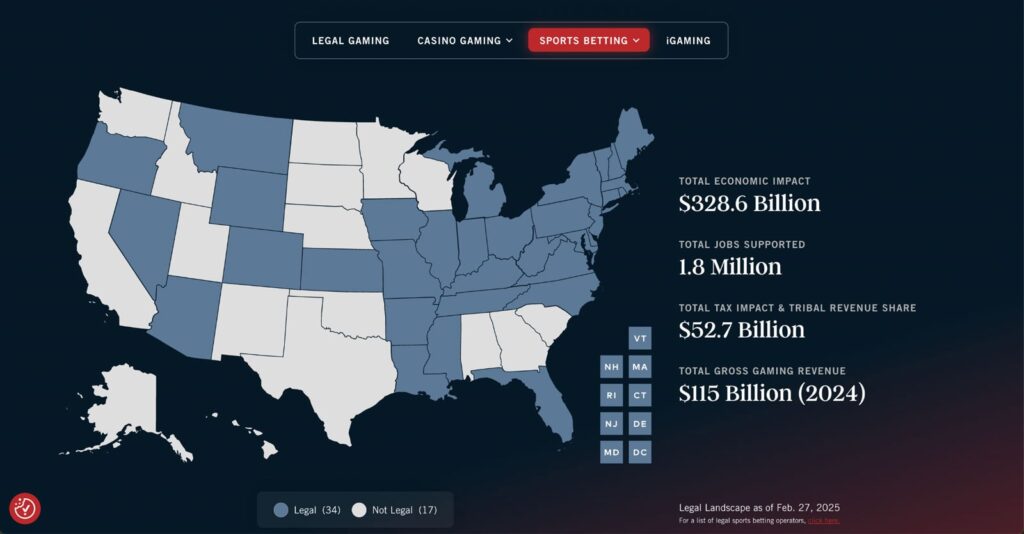
According to the American Gaming Association’s 2025 ‘State of Play’ map, 34 states plus Washington, D.C. have now legalized online sports betting in some form, highlighting just how widespread the shift in legal access has become.
As legalization spreads, the Pew data show that public sentiment is shifting in the opposite direction. Forty-three percent of Americans now view legalized betting as harmful — up nearly ten points since 2022 — and that shift spans every demographic, especially young adults targeted by nonstop ads. Additionally, findings from the National Council on Problem Gambling’s 2024 NGAGE survey reveal that 8% of U.S. adults — nearly 20 million people — experienced at least one indicator of problematic gambling behavior “many times” in the past year. Even as gambling participation rates remain steady, the harm is spreading beyond individuals to families, workplaces, and communities — confirming that gambling is no longer a private issue, but a cultural one.
Society’s delusion that gambling is “non-addictive” has to be destroyed. It’s not harmless; it hijacks the brain’s reward system. Each win floods the brain with dopamine, subtly rewiring motivation and decision-making. Over time, risk begins to feel like relief, and loss becomes fuel for continued play and increased harm. Gambling disorder is a real disease — not a moral weakness, not bad luck.
At Ethos, we see the wreckage — but also recovery. I’ve watched men rebuild integrity, reconnect with family, and rediscover peace through honesty and accountability. With compassion and evidence-based care, we help individuals see gambling disorder not as failure, but as a treatable condition that can be understood and overcome. Recovery begins the moment someone believes change is possible.
Featured image by Baishampayan Ghose